
Link: https://mdbaynews.com/2026/02/11/black-history-month-american-promise-flowers/
By Berney Flowers | Guest Commentary
Black History Month is not a footnote to American history. It is not an apology or a grievance. It is a record of strength—proof that the American experiment, though flawed and often unjust, has moved forward because American Blacks refused to abandon it.
The American Black story is not one of weakness. It is one of endurance. From slavery to Jim Crow to discriminatory housing and education policies, injustice was real and costly — yet it did not extinguish faith in the American promise. From the moment the first chains were broken—sometimes physically, always spiritually—American Blacks built, served, invented, led, and defended a nation that did not always defend them in return. And still, they stayed. They fought. They believed.
That is not victimhood. That is strength.
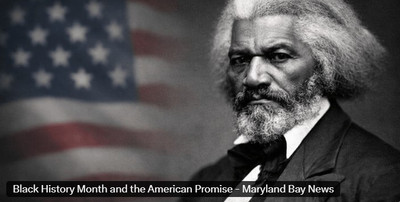
That strength is powerfully embodied by Frederick Douglass, born enslaved in Maryland and risen to become one of the most formidable moral voices in American history. Douglass did not merely escape slavery in Baltimore in 1838; he escaped the limits others tried to impose on his mind, his ambition, and his humanity. He turned personal bondage into national purpose, proving that resilience is not passive—it is disciplined, intentional, and courageous.
Douglass did not reject America. He challenged it. He appealed to the nation’s conscience and demanded that its founding principles be honored, not ignored. That distinction matters.
His relationship with President Abraham Lincoln captures this truth. Douglass approached Lincoln not as a subordinate, but as a moral equal. He pressed the president to confront slavery not as a political inconvenience, but as a national sin. He criticized Lincoln when emancipation moved too slowly, yet understood the weight of leadership and the cost of governing a divided nation.
In time, Lincoln came to value Douglass as a trusted voice of Black America—inviting him to the White House and seeking his counsel on emancipation and the enlistment of Black soldiers. Consider the courage it took for a man born enslaved in Maryland to confront the President of the United States—and help shape national policy. That is resilience in action.
Black resilience has always been practical. It appeared in families that endured generations of hardship without surrendering faith or responsibility. It lived in men and women who worked the hardest jobs for the lowest pay while raising children determined to do better. It took root in churches that became schools, meeting halls, and centers of self-reliance long before government intervention.
Resilience is a grandmother who demanded education when the system refused it.
Resilience is a father who wore a uniform for a country that questioned his worth.
Resilience is a community that rebuilt after discrimination, unrest, and neglect.
Black strength has rarely been loud. It has been the quiet strength of discipline, work ethic, and character. It built businesses without access to capital, families without safety nets, and communities without political power—but with moral grounding. Dignity did not come from permission. It came from character.
Throughout American history, American Blacks answered the call to serve. From the Revolutionary War to the present day, they defended a nation that had not yet fully embraced them. They served not because America was perfect, but because it was worth improving.
That is courage.
Courage is demanding equality without surrendering responsibility.
Courage is insisting on justice while respecting the rule of law.
Courage is strengthening the house—not burning it down.
American Blacks’ courage does not require tearing the country apart to build ourselves up. It has always insisted that America live up to its ideals. And when opportunity expanded, American Blacks seized it—building businesses, raising families, serving communities, and excelling across every profession.
Today, American Blacks are entrepreneurs, engineers, teachers, police officers, soldiers, pastors, doctors, and public servants. They mentor youth, anchor families, and hold communities together. This progress did not come from slogans or excuses. It came from perseverance, faith, and accountability.
Which brings us to unity.
Unity does not mean sameness. It means shared purpose. It means recognizing that while our experiences differ, our future is common. When American Blacks rose, America rose with them. When equality advanced, the nation became stronger, more stable, and more just.
We should reject narratives that trap American Blacks in permanent grievance or deny their agency. Those stories do not honor our ancestors—they diminish them. Our history is not defined solely by what was done to us, but by what we endured and overcame.
Black History Month should honor builders, not just protesters; faith, not just frustration; progress without denying hardship—and without being imprisoned by it. Resilience is patriotic. Courage is contagious. Unity is built when citizens hold the nation to its highest ideals.
The legacy of Frederick Douglass and Maryland’s Black freedom fighters is not merely history—it is a charge to every generation to strengthen the republic by insisting that liberty and justice apply to all.
That story is not over.
And it belongs to all of us.
Berney Flowers
VFAF National Political Director

Also catch Berney on his latest Newsmax hit:
